CNN Report Claims Warner Bros. Discovery Holds Minority Stake In AEW, Examines Politics In Modern Pro Wrestling

A new feature published by CNN.com examining the growing intersection between professional wrestling and political themes has sparked conversation for more than one reason.

While the article primarily focuses on what it describes as a “politically shaded rivalry” between AEW and WWE, it also makes a notable claim: that Warner Bros. Discovery — CNN’s parent company — owns a minority stake in AEW.

CNN’s Ownership Claim

In the piece, CNN writes:

“The embrace of contemporary issues is part of a larger, politically shaded rivalry playing out in the industry, between the 7-year-old AEW and the industry’s ruling juggernaut for generations, WWE (Warner Bros. Discovery, CNN’s parent corporation, owns a minority stake in AEW).”

That line has raised eyebrows, as AEW President Tony Khan has consistently avoided confirming whether WBD holds any equity in the promotion. Since at least 2023, Khan has repeatedly stated that he maintains full control over AEW’s decision-making, though he has not directly confirmed or denied whether Warner Bros. Discovery owns a financial stake.

If WBD’s ownership were to exceed 10 percent, it would generally require public disclosure due to securities regulations tied to publicly traded companies. As of now, no such filing has been publicly highlighted.

It also remains unclear whether any ownership component may have been included as part of AEW’s most recent media rights agreement with WBD.

What Happens If AEW Leaves WBD?

The ownership question becomes even more interesting when considering the broader corporate landscape.

Warner Bros. Discovery has been the subject of acquisition discussions, with Paramount and Netflix both reportedly exploring different types of deals.

  • Netflix’s reported proposal would involve acquiring WB’s film studio, HBO, and HBO Max, with linear television assets potentially spun off.
  • Paramount’s reported interest is in acquiring the entire company, keeping television networks and streaming assets under one umbrella.

If WBD does in fact own a minority stake in AEW, questions naturally follow:

  • What would happen if AEW signs a future media deal outside of WBD?
  • Would ownership transfer in a corporate acquisition?
  • Could that impact AEW’s long-term television positioning?

At this point, those questions remain speculative.

Politics In Pro Wrestling: A Long History

Beyond the ownership note, the article focuses heavily on how political themes continue to surface in wrestling storylines and fan reactions.

CNN points out that wrestling has historically drawn from real-world political tensions for dramatic effect. The article references Sgt. Slaughter’s infamous Gulf War-era heel turn, in which he aligned himself with Iraqi sympathies during the height of U.S. tensions — one of the most controversial angles in WWE history.

More recently, AEW has found itself at the center of attention following politically charged chants at live events.

“F— ICE” Chants At AEW Events

The article highlights chants that occurred during recent matches involving MJF and Brody King.

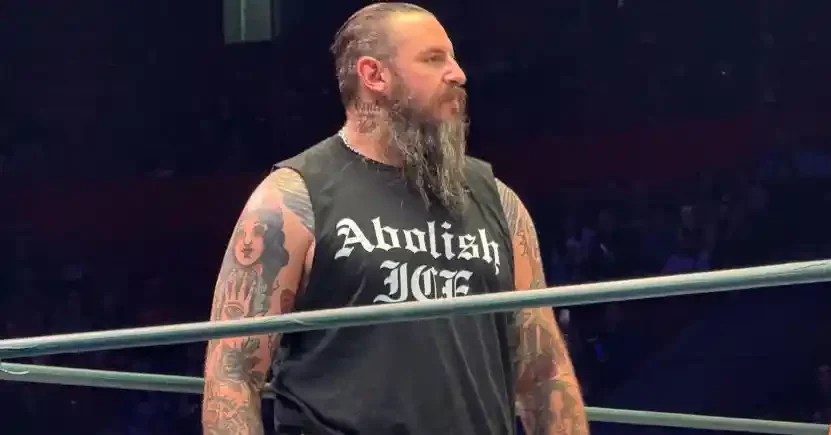
At AEW Grand Slam Mexico last June, King wore an “ABOLISH ICE” shirt. Fans in attendance at AEW Grand Slam Australia reportedly chanted “F— ICE” during King’s title match against MJF. That event is scheduled to air on tape delay at 8:00 PM ET on TNT and HBO Max.

CNN also quoted Eero Laine, a theatre professor at SUNY Buffalo who studies the history of professional wrestling. Laine noted that the chants were unusual in wrestling terms:

“They are interesting in that they support a political stance associated with one of the wrestlers, but they are not necessarily directly related to what’s happening in the ring. And the chant is not part of the repertoire of standard wrestling chants.”

AEW vs. WWE: A “Politically Shaded Rivalry”?

The broader framing of the article suggests that AEW and WWE’s competition is no longer limited strictly to ratings and creative direction, but also cultural positioning. While WWE has largely avoided overt political messaging in recent years, AEW crowds — and occasionally talent — have shown a greater willingness to reference contemporary issues.

Whether that reflects company philosophy or simply organic fan behavior is open to interpretation.

What is clear is that CNN’s mention of a potential Warner Bros. Discovery minority stake in AEW is likely to fuel renewed discussion about the true nature of the partnership between the media giant and the wrestling promotion.

As of this writing, AEW has not publicly addressed the claim.

WBD and AEW Shut Down Rumors Surrounding Brody King’s Dynamite Absence

Brody King’s absence from this week’s episode of AEW Dynamite quickly sparked speculation online — but both Warner Bros. Discovery and AEW are now firmly pushing back on the rumors.

The former challenger to MJF, who demolished the outspoken star last week to secure an AEW World Championship opportunity at Grand Slam: Australia, was noticeably missing from Wednesday night’s broadcast. That absence raised eyebrows, especially after Dave Meltzer reported that King had allegedly been pulled from the show at the request of Warner Bros. Discovery. According to the report, network officials were concerned King’s appearance could trigger more anti-ICE chants from fans, similar to the “F**k ICE” chants heard before his match with MJF.

However, WBD has flatly denied the claim.

In a statement issued to Wrestling Inc., the company made it clear they had no role in King’s scheduling.

“Warner Bros. Discovery did not have any involvement in Brody King’s upcoming AEW schedule,” the statement read. “Any speculation to the contrary is categorically false. Brody is scheduled to appear during the next AEW event, which will air this Saturday on TNT and HBO Max.”

When further pressed by Voices of Wrestling regarding the wording of the statement — specifically whether “upcoming” left room for involvement in King missing Dynamite — WBD reportedly reiterated that they had no part in his absence.

AEW also denied the rumors. According to Fightful Select, company sources stated that King’s absence had nothing to do with the network or last week’s chants. In fact, some within AEW reportedly said that Meltzer’s report was the first they had heard of such speculation.

So where was Brody King?

The answer appears far less controversial. PWInsider reports that King was among several AEW talents flying from LAX to Sydney, Australia, in preparation for Grand Slam: Australia. As a result, he was never scheduled to appear on Dynamite in the first place.

With King en route to Australia and a World Championship opportunity looming, it looks like this situation may simply be a case of travel logistics — not network interference.

All eyes now turn to Grand Slam: Australia, where King will look to capitalize on the momentum he built by steamrolling MJF and attempt to shock the world on an international stage.

Report: Warner Bros. Discovery Kept Brody King Off AEW Dynamite Over Fears of Anti-ICE Chants

A surprising backstage decision reportedly kept Brody King off this week’s episode of AEW Dynamite — and it may have had far more to do with corporate politics than creative direction.

According to Dave Meltzer on Wrestling Observer Radio, Warner Bros. Discovery made the call to hold King off the show following last week’s headline-making moment in Las Vegas. During that episode, King shocked viewers by defeating MJF in just over a minute. However, it wasn’t just the upset victory that grabbed attention. The live crowd broke into loud “F*** ICE” chants, which quickly made waves beyond the wrestling bubble.

Per Meltzer, WBD executives were concerned about a repeat of that scenario if King appeared again this week. The fear? That more anti-ICE chants could create unwanted controversy at a time when the company is reportedly navigating sensitive corporate matters — including a pending acquisition deal involving Netflix that would require regulatory approval.

Meltzer emphasized that the decision did not come from AEW President Tony Khan.

“This is from above,” Meltzer stated, noting that executives were wary of drawing negative attention that could complicate regulatory proceedings. He added that if not for the broader corporate landscape — particularly concerns about political sensitivities — the chants themselves may not have been treated as a major issue.

King has been outspoken in his criticism of Immigration and Customs Enforcement (ICE) and has been active in fundraising efforts to support immigrant communities. That public stance, combined with last week’s crowd reaction, reportedly made his presence a potential flashpoint for another viral moment.

The situation is particularly notable because, from a storyline standpoint, a follow-up segment between King and MJF seemed like a logical next step after last week’s decisive result. Instead, the angle was paused — at least for now.

This development highlights the increasingly complicated intersection of wrestling, corporate oversight, and political optics. AEW has often presented itself as an alternative product with a more organic crowd atmosphere, but as the company continues to operate under a major media conglomerate, those raw live reactions can sometimes create challenges at the executive level.

It remains to be seen how AEW will handle King’s return to television. If the Las Vegas crowd reaction is any indication, the issue may not simply disappear the next time he walks through the curtain.

For now, Brody King’s absence appears to be less about creative direction — and more about corporate caution.

Paramount Sweetens Hostile Takeover Bid for Warner Bros. Discovery Amid Netflix Battle – What It Could Mean for AEW

The corporate tug-of-war over Warner Bros. Discovery is heating up.

Paramount has officially submitted a revised offer in its hostile attempt to acquire WBD, aiming to counter Netflix’s existing agreement with the media giant. While the per-share price remains unchanged, the new proposal adds financial incentives designed to make the deal more attractive to shareholders — and raise the stakes in an already intense bidding war.

What Paramount Is Offering

Paramount’s amended bid keeps its original $30-per-share valuation intact but introduces a new $0.25-per-share “ticking fee.” This fee would accumulate for each quarter the deal remains unclosed after December 31 of this year, essentially rewarding shareholders if the transaction drags on.

In addition, Paramount is taking a bold step by offering to cover Netflix’s $2.8 billion termination fee should Warner Bros. Discovery walk away from its current agreement with the streaming giant.

For context, Netflix would face a massive $5.8 billion obligation if it were to back out of the deal on its own.

Paramount also claims it can address some of WBD’s financial concerns, including approximately $1.5 billion in fees tied to debt refinancing. According to the company, it has potential “solutions” in place to ease those burdens — another attempt to sway shareholders.

Where Things Stand with Netflix

Warner Bros. Discovery has responded cautiously, stating it will review Paramount’s revised proposal. However, the company is not changing its recommendation that shareholders approve Netflix’s offer.

Netflix recently adjusted its bid into a fully cash-based offer at $27.75 per share. Previously, the proposal included a combination of cash and stock options at the same valuation. The move to an all-cash deal was seen as a strategic play to strengthen Netflix’s position and reduce uncertainty.

Paramount, meanwhile, is urging shareholders to reject not only the Netflix agreement but also WBD’s planned spinoff of Discovery.

The AEW Factor

For wrestling fans, this isn’t just boardroom drama.

AEW’s future broadcast landscape is directly tied to Warner Bros. Discovery. According to recent filings, AEW would remain aligned with Discovery under the proposed spinoff structure, now referred to as Global Linear Networks. At the same time, AEW’s weekly programming and pay-per-view events are expected to continue streaming on HBO Max.

While none of the proposed corporate changes appear to immediately disrupt AEW’s current television and streaming setup, large-scale media mergers often bring long-term shifts in strategy, branding, and distribution priorities.

If Netflix ultimately acquires WBD, that could create intriguing possibilities regarding streaming integration and international reach. On the other hand, a successful Paramount takeover would reshape the media landscape in a completely different direction.

For now, AEW appears stable in its current arrangements — but the larger media chess match is far from over.

As this high-stakes battle between Paramount and Netflix unfolds, the ripple effects could extend well beyond Hollywood — and into the weekly world of professional wrestling.

AEW’s Streaming Future Unclear as Netflix Pushes All-Cash Deal for WBD

AEW may soon find itself caught in the middle of a major media power struggle, as Netflix and Warner Bros. Discovery continue reshaping their proposed merger. A newly revised all-cash offer has added urgency to the situation — and for wrestling fans, it raises real questions about where AEW programming could end up once the dust settles.

On January 20, Netflix and WBD confirmed they’ve restructured their merger agreement into a full cash deal, offering $27.75 per share for WBD. While the valuation hasn’t changed, the switch away from stock is a significant move. By removing equity from the equation, Netflix is clearly aiming to streamline regulatory approval and close the deal faster, limiting opportunities for rivals to interfere.

That hasn’t stopped Paramount from trying. The company has aggressively challenged the Netflix-WBD deal, filing lawsuits, launching a proxy battle, and even floating a competing bid reportedly valued at $30 per share. Paramount executives believe Netflix taking control would weaken WBD’s cable and sports assets — a category that directly includes TNT and TBS, the current home of AEW’s flagship programming.

At the heart of the issue is WBD’s planned breakup into two separate entities. Under the proposal, Warner Bros. would focus on studio and entertainment properties, while Discovery Global would house cable networks and sports. That structural split could play a decisive role in AEW’s future, especially when it comes to streaming.

Under earlier versions of the Netflix-WBD plan, live sports were not expected to remain a long-term priority on HBO Max. Instead, properties like AEW were projected to migrate to a standalone TNT Sports app. That direction appears unchanged under the new all-cash framework. While such a move might make sense from a corporate organization standpoint, it could significantly reduce AEW’s visibility compared to being featured on a major platform like Max.

Notably, the latest public statements from Netflix and WBD avoided mentioning AEW, TNT, or sports content by name. Instead, the messaging focused on innovation, growth, and consumer choice. Still, the emphasis on splitting the company into more “focused” units strongly suggests sports will be pushed into a more isolated ecosystem — one without the massive subscriber base of Netflix or HBO Max.

For AEW, that creates a tricky situation. Streaming exposure has become a crucial part of wrestling’s modern business model, not just for weekly TV but also for special events and international reach. A move to a brand-new TNT Sports app could require fans to actively seek out the product again, rather than stumbling upon it through a familiar platform. Casual viewers, in particular, may not make that jump.

The current timeline has the Netflix-WBD merger potentially closing within 12 to 18 months, assuming regulatory hurdles are cleared and the Discovery Global spinoff is completed. Paramount’s legal challenge remains a wild card, but the all-cash structure gives Netflix a cleaner pitch to shareholders eager for certainty.

If that path wins out, AEW’s time on Max may already be on the clock. While nothing is official yet, the broader media shakeup suggests AEW will need to stay flexible — and possibly proactive — about where its content lives long-term. In an era where accessibility often determines audience growth, the outcome of this deal could have ripple effects far beyond Wall Street, directly shaping how fans watch AEW in the years ahead.

Paramount Files Lawsuit Challenging Netflix Acquisition Of AEW Broadcast Partner Warner Bros.

AEW’s current media rights agreement with Warner Bros. Discovery still has a few years left on the clock, but that hasn’t stopped the wrestling world from keeping a close eye on what’s happening at the corporate level. The latest twist comes as Paramount has officially filed a lawsuit aimed at slowing down — or potentially derailing — Netflix’s proposed acquisition of WBD, AEW’s longtime broadcast partner.

According to reports from The Wrap, Paramount filed the lawsuit in Delaware this week, seeking to force WBD to provide detailed financial disclosures related to its decision to accept Netflix’s offer instead of Paramount’s reported $30-per-share bid. This legal move follows Paramount’s failed attempts at a hostile takeover, signaling a shift in strategy rather than a full retreat from the bidding war.

Paramount CEO David Ellison also revealed in a letter to shareholders that the company plans to nominate its own slate of board members at WBD’s next annual meeting. If successful, that maneuver could reopen negotiations and potentially push Netflix out of the picture. That said, even Ellison admitted the odds of Paramount ultimately acquiring WBD remain slim at this stage, making the move feel more like a last-ditch effort to stay relevant in the process.

From an AEW perspective, the end result may not dramatically change the landscape — at least not immediately. Both Netflix and Paramount already have business ties to TKO Group Holdings, WWE’s parent company. Paramount is about to kick off a multi-year UFC streaming deal, while Netflix recently celebrated the one-year anniversary of WWE Raw airing on its platform. Still, with AEW’s next rights negotiation eventually looming, the outcome of this media power struggle could quietly shape the company’s long-term broadcast future.

AEW’s Partnership With Warner Bros. Discovery Expected to Continue Despite Potential Network Sales

Despite ongoing speculation surrounding Warner Bros. Discovery’s future and the possible sale of its cable properties, AEW’s television situation appears to be on solid ground for the foreseeable future.

During a recent Fightful Select Q&A, Sean Ross Sapp addressed concerns from fans about what a potential WBD sale could mean for AEW programming on networks like TBS and TNT. According to Sapp, there’s currently little reason for alarm. Any sale of WBD’s cable assets is not expected to be finalized until late 2026 at the earliest, and AEW’s existing television deal already provides built-in protection through that period.

As it stands, AEW is guaranteed at least one more full year on its current agreement, with an additional option year that can be exercised. That structure is important, as it gives any potential new ownership flexibility. If a buyer sees value in AEW’s programming, they can simply trigger the option year and continue business as usual. If not, they can opt out without major financial risk.

One of the key factors working in AEW’s favor is its cost efficiency. Sapp noted that AEW covers its own production expenses, making the product relatively inexpensive for a network compared to scripted programming. In an era where cable networks are tightening budgets, wrestling remains attractive due to its steady ratings and loyal audience without the massive overhead costs of traditional television shows.

That balance of dependable viewership and low operational burden makes AEW an easy property to keep, even amid corporate restructuring or ownership changes. While Warner Bros. Discovery has not publicly commented on how a sale might impact its wrestling content, all signs point to continuity rather than disruption.

AEW President Tony Khan has also expressed optimism about the relationship, recently stating his hope that the partnership with WBD continues for at least the next two years. Given the contractual safeguards already in place and AEW’s value as a consistent cable draw, that confidence appears well-founded.

For now, AEW fans can breathe easy. Even with uncertainty surrounding the broader media landscape, Dynamite and Collision don’t appear to be going anywhere anytime soon.

Warner Bros. Discovery Rejects Paramount’s Hostile Takeover Offer

The fight over control of Warner Bros. Discovery is heating up, and it could have ripple effects across the entertainment landscape — including All Elite Wrestling.

Warner Bros. Discovery, AEW’s longtime broadcast and streaming partner, has officially rejected a hostile acquisition attempt from the Paramount Skydance group led by David Ellison. The move comes after WBD recently agreed to a major deal with Netflix, which would see the streaming giant acquire a significant portion of WBD’s assets, including Warner Bros. Pictures and HBO Max.

Following that agreement, Paramount launched an aggressive all-cash tender offer directly to WBD shareholders, offering $30 per share and valuing the company at roughly $108 billion. Unlike Netflix’s proposal, Paramount’s bid would include WBD’s entire portfolio, including its linear television networks.

According to The Hollywood Reporter, WBD’s board has now formally rejected Paramount’s offer, telling shareholders it is “inferior” to Netflix’s deal and warning that the bid carries “numerous significant risks and costs.” With that decision made, Paramount’s options are limited: either convince shareholders to sell at the current price or return with a higher offer in hopes of disrupting the Netflix agreement.

WBD Board Chair Samuel A. Di Piazza, Jr. said the rejection followed a comprehensive review of Paramount’s proposal. In a statement, Di Piazza said the board determined the offer undervalued the company while placing unnecessary risk on shareholders. He added that the bid failed to resolve issues WBD had already raised during discussions around Paramount’s six previous proposals.

Di Piazza emphasized that WBD believes the Netflix transaction offers stronger and more certain value, stating the company is confident in the long-term upside of that partnership.

THR noted that the board’s response was widely expected. Paramount’s tender offer closely resembled a proposal submitted earlier in December, shortly before WBD finalized its agreement with Netflix. WBD has repeatedly expressed concerns about Paramount’s financing, particularly questions surrounding foreign investment and whether Oracle founder Larry Ellison would fully guarantee the deal.

In a December 17 filing, WBD specifically pointed to issues with the backstop provided by Ellison’s revocable trust, citing a lack of transparency regarding the trust’s assets and liabilities. The filing also raised red flags about funding tied to Middle East sovereign wealth funds, including $10 billion from Saudi Arabia’s Public Investment Fund, $7 billion from Abu Dhabi, and another $7 billion from the Qatar Investment Authority.

Paramount has already had to adjust its financing structure. Tencent, which was expected to contribute $1 billion, was removed from the bid, while Jared Kushner’s Affinity Partners has reportedly pulled out of a $200 million commitment. WBD has also stated it sees no meaningful regulatory advantage in Paramount’s proposal compared to Netflix’s.

Looking ahead, THR reports that Ellison and his team were waiting on WBD’s response before deciding their next move. If Paramount increases its offer, Netflix would have the opportunity to counter, potentially setting off a full-scale bidding war. Netflix, for its part, sent a letter to shareholders on December 17 calling its proposal “the right deal, with the right partner, at the right time.”

The report also revealed that Ellison texted WBD CEO David Zaslav just hours before the Netflix deal was finalized, signaling Paramount’s willingness to go higher than $30 per share. Notably, Ellison pointed out that the offer was not labeled “best and final.”

Despite the rejection, Paramount reaffirmed its $30 per share tender offer in a statement released today. Ellison reiterated his belief in the deal, arguing it offers superior value, a clearer path to closing, and avoids leaving shareholders with what he described as an overleveraged linear TV business.

Ellison and senior Paramount executives have continued lobbying investors, including at a recent UBS conference in New York. One attendee told THR they left believing Paramount is prepared to raise its bid and questioned whether Netflix could realistically match a higher offer given recent stock movement following the $83 billion announcement.

With several major WBD shareholders reportedly intrigued by Paramount’s all-cash proposal, pressure could continue to mount. If Paramount ups the ante, WBD may yet find itself forced to reconsider — setting the stage for an even bigger showdown in the media world.

Paramount’s Surprise Bid for Warner Bros. Discovery Could Complicate Netflix’s Plans – And AEW’s Future Home

The media war around Warner Bros. Discovery (WBD) just got a lot more chaotic — and the ripple effects could eventually reach AEW.

Over the past week, Netflix had been moving toward a massive $82.7 billion deal that would carve up WBD, taking control of Warner Bros. Studios, HBO, and HBO Max while spinning off the cable networks into a separate company. That deal, while far from finalized, had the potential to shake up WBD’s structure but wasn’t expected to immediately disrupt AEW’s presence on TNT, TBS, or Max.

But now Paramount has stormed into the picture with what several outlets are calling a hostile takeover attempt. The newly formed Paramount Skydance has reportedly put a $108.4 billion offer on the table — translating to $30 per WBD share, surpassing Netflix’s bid of roughly $27.75 per share.

According to Variety and other industry reports, WBD has acknowledged receiving Paramount’s unsolicited proposal and has 10 business days to make a formal decision.

If Netflix’s bid ultimately collapses, the streamer would owe WBD a hefty $5.8 billion breakup fee.

Paramount issued a statement to Deadline, touting its offer as a more stable, less complicated option for WBD shareholders — and taking a not-so-subtle swipe at Netflix’s deal by framing it as riskier and tied to a lengthy regulatory process.


What Does This Mean for AEW?

In the short term, nothing changes. AEW’s existing media rights agreement with WBD runs through 2027, with an option year into 2028, covering TNT, TBS, and Max for Dynamite, Collision, and pay-per-view distribution.

However, the long-term landscape could get messier depending on which company wins out:

  • If Netflix somehow prevails:
    AEW’s content might end up shifting on the streaming side, especially if HBO Max gets restructured or folded into Netflix. But again, this wouldn’t immediately alter their TV homes on TNT/TBS.
  • If Paramount takes over WBD:
    Things get more interesting. Paramount already has a huge deal in place with UFC — a 7-year, $7.7 billion agreement beginning in 2026 — making Paramount+ the exclusive streaming home for UFC. Could Paramount want both UFC and AEW under its umbrella? Would they see AEW as redundant? Or would they look to bolster their sports/entertainment portfolio even more?

There’s no clear answer yet, but it’s a scenario worth watching.


AEW’s Stability vs. a Turbulent Media Market

With Hollywood and the streaming world in full consolidation mode, AEW finds itself tied to a partner that major companies are fighting over. That could either strengthen their position or leave them navigating a new corporate owner with new priorities.

For now, AEW is safe and locked in. But as the Paramount vs. Netflix drama unfolds, Tony Khan’s promotion may once again find its fate linked to boardroom battles far outside the wrestling ring.

Netflix Acquires Warner Bros.

The media world woke up to a bombshell: after months of speculation, Netflix has officially struck a deal to acquire Warner Bros. If regulators sign off, this move could put the streaming rights to both WWE and AEW under the same corporate roof — something unthinkable just a year ago.

What Netflix Is Actually Buying

Netflix confirmed that the agreement includes the Warner Bros. movie and TV studios, along with HBO and the HBO Max platform. However, the previously announced internal split at Warner Bros. Discovery is still happening. Once the dust settles:

  • Netflix gets the Warner Bros. studio assets and HBO/HBO Max
  • Discovery Global becomes its own separate company, holding cable networks like TBS, TNT, and Discovery Channel

That separation is crucial. While Netflix gains major entertainment brands, the networks that actually air AEW programming will live under the Discovery side, not Netflix.

For now, Netflix says HBO Max will continue operating as-is — a temporary situation at best, given Netflix’s long-term strategy.

Where Does This Leave AEW?

AEW’s future is the biggest question mark in all of this.

The promotion only recently locked in a multi-year extension with WBD, keeping AEW Dynamite and AEW Collision on TBS and TNT. That deal should theoretically keep AEW secure for several years, but big mergers often come with hidden contract escape clauses, restructuring options, or renegotiation triggers.

And then there’s the ownership wrinkle: WBD was reported to own a small equity stake in AEW. Once the company splits into two and Netflix acquires half, it’s unclear where that ownership slice will land — Discovery Global, Netflix, or somewhere else entirely.

Meanwhile, WWE’s Netflix Partnership Keeps Growing

WWE already has one foot firmly planted in the Netflix world. At the start of 2025, Raw officially left cable and debuted as a Netflix-exclusive show in the U.S. The streaming giant also hosts multiple WWE programs overseas, and although American PLEs are now tied to ESPN+, Netflix remains one of WWE’s most important global partners.

If the Warner Bros. acquisition goes through, Netflix could find itself with indirect ties to both major wrestling promotions — an unprecedented situation.

Potential Industry-Wide Ripple Effects

The landscape for wrestling media rights was already shifting rapidly, and this deal could accelerate those changes. AEW may face downstream effects depending on who controls the networks airing their shows and who ends up holding that reported ownership stake. WWE’s relationship with Netflix could deepen or evolve as the company absorbs massive new assets.

For fans, this could eventually influence where and how they watch both WWE and AEW programming — especially as streaming services consolidate and content libraries merge.

One thing is clear: Netflix’s bold move is reshaping the entertainment world, and the wrestling industry may be heading toward one of its most unpredictable media eras yet.

Netflix press release:

NETFLIX TO ACQUIRE WARNER BROS. FOLLOWING THE SEPARATION OF DISCOVERY GLOBAL FOR A TOTAL ENTERPRISE VALUE OF $82.7 BILLION (Equity Value of $72.0 Billion)
Dec 05, 2025

Transaction Unites Warner Bros.’ Iconic Franchises and Storied Libraries with Netflix’s Leading Entertainment Service, Creating an Extraordinary Offering for Consumers

Netflix to Maintain Warner Bros.’ Current Operations

Combination Will Offer More Choice and Greater Value for Consumers, Create More Opportunities for the Creative Community and Generate Shareholder Value

Acquisition Will Strengthen the Entertainment Industry

HOLLYWOOD, Calif., Dec. 5, 2025 /PRNewswire/ — Today, Netflix, Inc. (the Company) and Warner Bros. Discovery, Inc. (WBD) announced they have entered into a definitive agreement under which Netflix will acquire Warner Bros., including its film and television studios, HBO Max and HBO.

NETFLIX TO ACQUIRE WARNER BROS.(opens in a new window)

The cash and stock transaction is valued at $27.75 per WBD share (subject to a collar as detailed below), with a total enterprise value of approximately $82.7 billion (equity value of $72.0 billion). The transaction is expected to close after the previously announced separation of WBD’s Global Networks division, Discovery Global, into a new publicly-traded company, which is now expected to be completed in Q3 2026.

This acquisition brings together two pioneering entertainment businesses, combining Netflix’s innovation, global reach and best-in-class streaming service with Warner Bros.’ century-long legacy of world-class storytelling. Beloved franchises, shows and movies such as The Big Bang Theory, The Sopranos, Game of Thrones, The Wizard of Oz and the DC Universe will join Netflix’s extensive portfolio including Wednesday, Money Heist, Bridgerton, Adolescenceand Extraction, creating an extraordinary entertainment offering for audiences worldwide.

“Our mission has always been to entertain the world,” said Ted Sarandos, co-CEO of Netflix. “By combining Warner Bros.’ incredible library of shows and movies—from timeless classics like Casablancaand Citizen Kaneto modern favorites like Harry Potter and Friends—with our culture-defining titles like Stranger Things, KPop Demon Hunters and Squid Game, we’ll be able to do that even better. Together, we can give audiences more of what they love and help define the next century of storytelling.”

“This acquisition will improve our offering and accelerate our business for decades to come,” continued Greg Peters, co-CEO of Netflix. “Warner Bros. has helped define entertainment for more than a century and continues to do so with phenomenal creative executives and production capabilities. With our global reach and proven business model, we can introduce a broader audience to the worlds they create—giving our members more options, attracting more fans to our best-in-class streaming service, strengthening the entire entertainment industry and creating more value for shareholders.”

“Today’s announcement combines two of the greatest storytelling companies in the world to bring to even more people the entertainment they love to watch the most,” said David Zaslav, President and CEO of Warner Bros. Discovery. “For more than a century, Warner Bros. has thrilled audiences, captured the world’s attention, and shaped our culture. By coming together with Netflix, we will ensure people everywhere will continue to enjoy the world’s most resonant stories for generations to come.”

Combination Will Offer More Choice, More Opportunities, More Value

Complementary strengths and assets: Warner Bros.’ studios are world-class, with Warner Bros. recognized as a leading supplier of television titles and filmed entertainment. HBO and HBO Max also provide a compelling, complementary offering for consumers. Netflix expects to maintain Warner Bros.’ current operations and build on its strengths, including theatrical releases for films.
More choice and greater value for consumers: By adding the deep film and TV libraries and HBO and HBO Max programming, Netflix members will have even more high-quality titles from which to choose. This also allows Netflix to optimize its plans for consumers, enhancing viewing options and expanding access to content.
A stronger entertainment industry: This acquisition will enhance Netflix’s studio capabilities, allowing the Company to significantly expand U.S. production capacity and continue to grow investment in original content over the long term which will create jobs and strengthen the entertainment industry.
More opportunities for the creative community: By uniting Netflix’s member experience and global reach with Warner Bros.’ renowned franchises and extensive library, the Company will create greater value for talent—offering more opportunities to work with beloved intellectual property, tell new stories and connect with a wider audience than ever before.
More value for shareholders: By offering members a wider selection of quality series and films, Netflix expects to attract and retain more members, drive more engagement and generate incremental revenue and operating income. The Company also expects to realize at least $2-3 billion of cost savings per year by the third year and expects the transaction to be accretive to GAAP earnings per share by year two.
Transaction Details and Timing

Under the terms of the agreement, each WBD shareholder will receive $23.25 in cash and $4.501 in shares of Netflix common stock for each share of WBD common stock outstanding at the closing of the transaction. The transaction values Warner Bros. Discovery at $27.75 per share, implying a total equity value of approximately $72.0 billion and an enterprise value of approximately $82.7 billion.

In June 2025, WBD announced plans to separate(opens in a new window) its Streaming & Studios and Global Networks divisions into two separate publicly traded companies. This separation is now expected to be completed in Q3 2026, prior to the closing of this transaction. The newly separated publicly traded company holding the Global Networks division, Discovery Global, will include premier entertainment, sports and news television brands around the world including CNN, TNT Sports in the U.S., and Discovery, free-to-air channels across Europe, and digital products such as Discovery+ and Bleacher Report.

The stock component is subject to a collar under which WBD shareholders will receive Netflix stock valued at $4.50 per share, provided the 15-day volume weighted average price (“VWAP”) of Netflix stock price (measured three trading days prior to closing) falls between $97.91 and $119.67. If the VWAP is below $97.91, WBD shareholders will receive 0.0460 Netflix shares for each WBD share. If the VWAP is above $119.67, WBD shareholders will receive 0.0376 Netflix shares for each WBD share.

The transaction was unanimously approved by the Boards of Directors of both Netflix and WBD. In addition to the completion of the separation of Discovery Global (WBD’s Global Networks business), completion of the transaction is subject to required regulatory approvals, approval of WBD shareholders and other customary closing conditions. The transaction is expected to close in 12-18 months.

Moelis & Company LLC is acting as Netflix’s financial advisor and Skadden, Arps, Slate, Meagher & Flom LLP is serving as legal counsel. Wells Fargo is acting as an additional financial advisor and, along with BNP and HSBC, is providing committed debt financing related to the transaction.

Allen & Company, J.P. Morgan and Evercore are serving as financial advisors to Warner Bros. Discovery and Wachtell Lipton, Rosen & Katz and Debevoise & Plimpton LLP are serving as legal counsel.

Webcast

Netflix will conduct a conference call today at 5:00am PT/8:00am ET to discuss the contents of this release. A link to the live webcast of the conference call will be available at https://ir.netflix.net/(opens in a new window).

IMPORTANT INFORMATION AND WHERE TO FIND IT

In connection with the proposed transaction (the “Merger”) between Netflix, Inc. (“Netflix”) and Warner Bros. Discovery, Inc. (“WBD”), Netflix intends to file with the U.S. Securities and Exchange Commission (the “SEC”) a registration statement on Form S-4 (the “Registration Statement”), which will include a prospectus with respect to the shares of Netflix’s common stock to be issued in the Merger and a proxy statement for WBD’s stockholders (the “Proxy Statement/Prospectus”), and WBD intends to file with the SEC the proxy statement. The definitive proxy statement (if and when available) will be mailed to stockholders of WBD. WBD also intends to file a registration statement for a newly formed subsidiary (“Discovery Global”), which is contemplated to own certain assets and businesses of WBD not being acquired by Netflix in connection with the Merger. Each of Netflix and WBD may also file with or furnish to the SEC other relevant documents regarding the Merger. This communication is not a substitute for the Registration Statement, the Proxy Statement/Prospectus or any other document that Netflix or WBD may file with the SEC or mail to WBD’s stockholders in connection with the Merger.

INVESTORS AND SECURITY HOLDERS OF NETFLIX AND WBD ARE URGED TO READ THE REGISTRATION STATEMENT AND THE PROXY STATEMENT/PROSPECTUS INCLUDED WITHIN THE REGISTRATION STATEMENT WHEN THEY BECOME AVAILABLE, AS WELL AS ANY OTHER RELEVANT DOCUMENTS FILED WITH THE SEC IN CONNECTION WITH THE MERGER OR INCORPORATED BY REFERENCE INTO THE REGISTRATION STATEMENT AND THE PROXY STATEMENT/PROSPECTUS (INCLUDING ANY AMENDMENTS OR SUPPLEMENTS THERETO), BECAUSE THEY WILL CONTAIN IMPORTANT INFORMATION REGARDING NETFLIX, WBD, THE MERGER AND RELATED MATTERS.

The documents filed by Netflix with the SEC also may be obtained free of charge at Netflix’s website at https://ir.netflix.net/home/default.aspx. The documents filed by WBD with the SEC also may be obtained free of charge at WBD’s website at https://ir.wbd.com.

PARTICIPANTS IN THE SOLICITATION

Netflix, WBD and certain of their respective directors and executive officers may be deemed to be participants in the solicitation of proxies from the stockholders of WBD in connection with the Merger under the rules of the SEC.

Information about the interests of the directors and executive officers of Netflix and WBD and other persons who may be deemed to be participants in the solicitation of stockholders of WBD in connection with the Merger and a description of their direct and indirect interests, by security holdings or otherwise, will be included in the Proxy Statement/Prospectus, which will be filed with the SEC.

Information about WBD’s directors and executive officers is set forth in WBD’s proxy statement for its 2025 Annual Meeting of Stockholders on Schedule 14A filed with the SEC on April 23, 2025, WBD’s Annual Report on Form 10-K for the year ended December 31, 2024, and any subsequent filings with the SEC. Information about Netflix’s directors and executive officers is set forth in Netflix’s proxy statement for its 2025 Annual Meeting of Stockholders on Schedule 14A filed with the SEC on April 17, 2025, and any subsequent filings with the SEC. Additional information regarding the direct and indirect interests of those persons and other persons who may be deemed participants in the Merger may be obtained by reading the Proxy Statement/Prospectus regarding the Merger when it becomes available. Free copies of these documents may be obtained as described above.

NO OFFER OR SOLICITATION

This communication is for informational purposes only and does not constitute, or form a part of, an offer to sell or the solicitation of an offer to buy any securities or a solicitation of any vote or approval, nor shall there be any sale of securities in any jurisdiction in which such offer, solicitation or sale would be unlawful prior to registration or qualification under the securities laws of any such jurisdiction. No offer of securities shall be made except by means of a prospectus meeting the requirements of Section 10 of the Securities Act of 1933, as amended, and otherwise in accordance with applicable law.

CAUTIONARY NOTE REGARDING FORWARD LOOKING STATEMENTS

This document contains “forward-looking statements” within the meaning of the federal securities laws, including Section 27A of the U.S. Securities Act of 1933, as amended, and Section 21E of the Securities Exchange Act of 1934, as amended. These forward-looking statements are based on Netflix’s and WBD’s current expectations, estimates and projections about the expected date of closing of the Merger and the potential benefits thereof, their respective businesses and industries, management’s beliefs and certain assumptions made by Netflix and WBD, all of which are subject to change. All forward-looking statements by their nature address matters that involve risks and uncertainties, many of which are beyond our control and are not guarantees of future results, such as statements about the consummation of the Merger and the anticipated benefits thereof. These and other forward-looking statements, including the failure to consummate the Merger or to make or take any filing or other action required to consummate the transaction on a timely matter or at all, are not guarantees of future results and are subject to risks, uncertainties and assumptions that could cause actual results to differ materially from those expressed in any forward-looking statements. Accordingly, there are or will be important factors that could cause actual results to differ materially from those indicated in such statements and, therefore, you should not place undue reliance on any such statements and caution must be exercised in relying on forward-looking statements. Important risk factors that may cause such a difference include, but are not limited to: (i) the completion of the Merger on anticipated terms and timing, including obtaining stockholder and regulatory approvals, completing the separation of WBD’s Global Networks business and Streaming and Studios business, anticipated tax treatment, unforeseen liabilities, future capital expenditures, revenues, expenses, earnings, synergies, economic performance, indebtedness, financial condition, losses, future prospects, business and management strategies, expansion and growth of WBD’s and Netflix’s businesses and other conditions to the completion of the Merger; (ii) failure to realize the anticipated benefits of the Merger, including as a result of delay in completing the transaction or integrating the businesses of Netflix and WBD; (iii) Netflix’s and WBD’s ability to implement their business strategies; (iv) consumer viewing trends; (v) potential litigation relating to the Merger that could be instituted against Netflix, WBD or their respective directors; (vi) the risk that disruptions from the Merger will harm Netflix’s or WBD’s business, including current plans and operations; (vii) the ability of Netflix or WBD to retain and hire key personnel; (viii) potential adverse reactions or changes to business relationships resulting from the announcement, pendency or completion of the Merger; (ix) uncertainty as to the long-term value of Netflix’s common stock; (x) legislative, regulatory and economic developments affecting Netflix’s and WBD’s businesses; (xi) general economic and market developments and conditions; (xii) the evolving legal, regulatory and tax regimes under which Netflix and WBD operate; (xiii) potential business uncertainty, including changes to existing business relationships, during the pendency of the Merger that could affect Netflix’s or WBD’s financial performance; (xiv) restrictions during the pendency of the Merger that may impact Netflix’s or WBD’s ability to pursue certain business opportunities or strategic transactions; and (xv) failure to receive the approval of the stockholders of WBD. These risks, as well as other risks associated with the Merger, will be more fully discussed in the Registration Statement and Proxy Statement/Prospectus to be filed with the SEC in connection with the Merger and the registration statement to be filed with the SEC in connection with the separation. While the list of factors presented here is, and the list of factors presented in the Registration Statement and Proxy Statement/Prospectus will be, considered representative, no such list should be considered to be a complete statement of all potential risks and uncertainties. Unlisted factors may present significant additional obstacles to the realization of forward-looking statements. Consequences of material differences in results as compared with those anticipated in the forward-looking statements could include, among other things, business disruption, operational problems, financial loss, legal liability to third parties and similar risks, any of which could have a material adverse effect on Netflix’s or WBD’s consolidated financial condition, results of operations or liquidity. The forward-looking statements included in this communication are made only as of the date hereof. Neither Netflix nor WBD assumes any obligation to publicly provide revisions or updates to any forward-looking statements, whether as a result of new information, future developments or otherwise, should circumstances change, except as otherwise required by securities and other applicable laws.

1 Reflects a 10% symmetrical collar.